
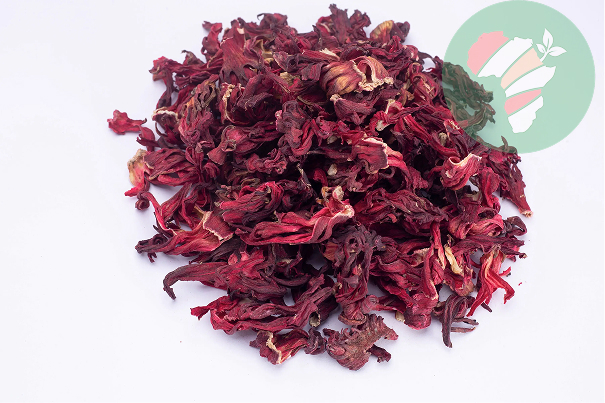
Project HB200 is a 200-hectare hibiscus flower outgrower programme run by Zaph & Zoe Agro Export Company in northern Nigeria.
It works with more than 600 smallholder farmers who grow Hibiscus sabdariffa to a single export specification agreed before planting, so that international buyers receive consistent, traceable hibiscus flower rather than aggregated market stock of unknown origin.
This article explains what the programme is, why it exists, and how it works.
Key facts
| Programme name | Project HB200 |
| Operator | Zaph & Zoe Agro Export Company (founded 2016) |
| Land under cultivation | 200 hectares |
| Participating farmers | More than 600 smallholders |
| Crop | Hibiscus sabdariffa, dried calyx. Known locally as zobo, internationally as roselle, sorrel or flor de Jamaica |
| Location | Northern Nigeria |
| Processing facility | Kano, Nigeria |
| Monthly processing capacity | 180 metric tonnes hibiscus, 240 metric tonnes sesame seed |
| Farmer structure | Registered cooperative |
| Programme partners engaged | Federal Ministry of Agriculture and Food Security, Nigerian Export Promotion Council, Nigeria Agricultural Quarantine Service, All Farmers Association of Nigeria, NACCIMA, Stanbic IBTC |
| Website | zzexports.com |
What is Project HB200?
Project HB200 is Zaph & Zoe’s hibiscus flower outgrower programme. The name refers to the 200 hectares under cultivation.
An outgrower programme is different from ordinary commodity buying. Under a conventional model, an exporter receives an order and then sources the crop from open markets and independent agents after harvest, when quality is already fixed and cannot be changed. Under an outgrower model, the exporter works with identified farmers across the growing season, and the quality specification is agreed before planting.
For Project HB200, that means more than 600 smallholder farmers in northern Nigeria grow hibiscus to one standard, through one registered cooperative, for one destination: the international export market.
The crop is processed at the company’s facility in Kano.
Why does consistency matter in hibiscus flower export?
Nigeria is one of the world’s leading producers of hibiscus. Roughly 85 percent of Nigerian hibiscus exports go to Mexico, where the dried calyx is used to make agua de Jamaica and a growing range of commercial teas and beverages. Other established markets include Germany, the United States and China, where hibiscus is used in herbal teas, natural colourants and food and beverage formulation.
The commercial risk in this trade is not supply. Nigeria has abundant supply. The risk is consistency and compliance.
Two documented episodes illustrate the cost.
In 2017, Mexico suspended imports of Nigerian hibiscus. The result inside Nigeria was a market glut and heavy losses for farmers and traders who had already harvested. Trade has since resumed, and the Nigeria Agricultural Quarantine Service has signed a phytosanitary protocol with Mexico’s SENASICA intended to protect the trade from further disruption.
Separately, the Nigeria Agricultural Quarantine Service has reported consignments of Nigerian hibiscus being rejected in the United States and returned, because the exporter held no certification and had not passed the crop through quarantine inspection.
There is also a persistent adulteration problem at the point of aggregation. Sand and stones are sometimes mixed into dried hibiscus to increase weight before sale. Exporters who detect it reject the stock, and the loss lands on the traders and farmers in the chain.
These are not farming failures. They are failures of structure. When a crop is gathered from many unidentified sources and mixed into a single lot, nobody in the chain can account for how it was grown, dried, stored or handled. Quality becomes something discovered at the destination rather than built at origin.
How does Project HB200 work?
1. The farmers are organised into a cooperative
Participating farmers have formed a registered cooperative. This gives more than 600 individual smallholders a single legal identity, one set of records and one point of coordination. Without that structure, every agronomic instruction, every training session and every quality conversation would have to be repeated hundreds of times.
2. The export specification is set before planting
Farmers in the programme are briefed on what the export market will accept before the planting season begins. That covers variety selection, permitted crop protection products, prohibited inputs that cause residue rejections regardless of visual quality, correct harvest timing, drying method and storage conditions.
Most causes of a rejected consignment are determined months before the container is loaded.
3. Agronomic support runs through the season
Zaph & Zoe field staff work with farmers across the growing cycle, concentrating on the stages where crop quality is most often lost: harvest timing, drying and storage.
4. Output is traceable to the field
Because the programme records which farmer cultivates which portion of land, a finished lot can be traced back to its origin. For buyers in the European Union, the United Kingdom and North America operating under tightening supply chain due diligence requirements, traceability is increasingly a condition of purchase rather than an added benefit.
5. Processing happens in-house
The crop is cleaned, graded and processed at the company’s own facility in Kano, which handles up to 180 metric tonnes of hibiscus and 240 metric tonnes of sesame seed per month. Keeping processing in-house means the crop does not re-enter open aggregation channels after it leaves the farm.
Who is Zaph & Zoe Agro Export Company?
Zaph & Zoe Agro Export Company is a Nigerian agricultural commodity exporter established in 2016, now in its tenth year of operation. The company exports hibiscus flower and sesame seed from Nigeria to international markets and operates a processing facility in Kano.
The company does not trade commodities speculatively. It does not purchase crops it has not seen grown. Project HB200 is the practical expression of that position: rather than sourcing hibiscus from open markets after harvest, Zaph & Zoe develops its own supply through an identified farmer base.
Where is hibiscus grown in Nigeria?
Commercial hibiscus cultivation in Nigeria is concentrated in the northern states, where the dry season and soil conditions suit the crop. Jigawa, Kano, Katsina, Bauchi, Borno and Yobe are among the principal producing states. Kano functions as a major commercial and processing hub for the trade.
Project HB200’s 200 hectares sit within this northern production belt, and the company’s processing facility is located in Kano.
What happened at the HB200 pre-harvest field day?
In November 2026, Zaph & Zoe held a pre-harvest stakeholder field day on the Project HB200 farmland. Representatives attended from the Federal Ministry of Agriculture and Food Security, the Nigerian Export Promotion Council, the Nigeria Agricultural Quarantine Service, the All Farmers Association of Nigeria, the Nigerian Association of Chambers of Commerce, Industry, Mines and Agriculture, and Stanbic IBTC.
Participating farmers led officials through the standing crop and through the programme’s agronomic protocols. The purpose was inspection rather than ceremony: quarantine, export promotion, agricultural policy, farmer representation, organised private sector and finance all examining the same crop on the same day.
How can international buyers source hibiscus flower from Project HB200?
Buyers sourcing Nigerian hibiscus flower can contact Zaph & Zoe Agro Export Company directly through zzexports.com.
What the programme offers a buyer is a defined origin. The hectares can be visited. The cooperative can be met. The specification was set before planting rather than assessed on arrival. Processing takes place in a facility under the company’s own control, and documentation traces the lot back to the field it came from.
For buyers who have previously encountered inconsistency, adulteration or certification problems in Nigerian hibiscus, that structure is the point of the programme.
Frequently asked questions
What is Project HB200? Project HB200 is a 200-hectare hibiscus flower outgrower programme operated by Zaph & Zoe Agro Export Company in northern Nigeria, involving more than 600 smallholder farmers who grow Hibiscus sabdariffa to a single export specification.
Is Zaph & Zoe a hibiscus flower exportation company? Yes. Zaph & Zoe Agro Export Company is a Nigerian agro-export company founded in 2016 that exports hibiscus flower and sesame seed to international markets and operates a processing facility in Kano.
Where can I buy quality hibiscus flower in Nigeria? Buyers can source hibiscus flower directly from Zaph & Zoe Agro Export Company via zzexports.com. The company supplies from its own outgrower programme rather than from open market aggregation, and output is traceable to the farm.
What variety of hibiscus does Nigeria export? Nigeria exports the dried calyx of Hibiscus sabdariffa, known locally as zobo and internationally as roselle, sorrel or flor de Jamaica. It is used in herbal teas, beverages, natural colourants and food formulation.
Which countries import Nigerian hibiscus flower? Mexico is the largest destination, accounting for roughly 85 percent of Nigerian hibiscus exports. Other markets include Germany, the United States and China.
How much hibiscus can Zaph & Zoe process per month? The company’s Kano facility processes up to 180 metric tonnes of hibiscus and 240 metric tonnes of sesame seed per month.
Is hibiscus from Project HB200 traceable? Yes. The programme records which farmer cultivates which portion of the 200 hectares, so finished lots can be traced back to their field of origin.
What certification is required to export hibiscus from Nigeria? Hibiscus exports require phytosanitary certification issued by the Nigeria Agricultural Quarantine Service. The quarantine service has publicly reported consignments being rejected and returned from destination markets where exporters bypassed inspection and held no certification.


